
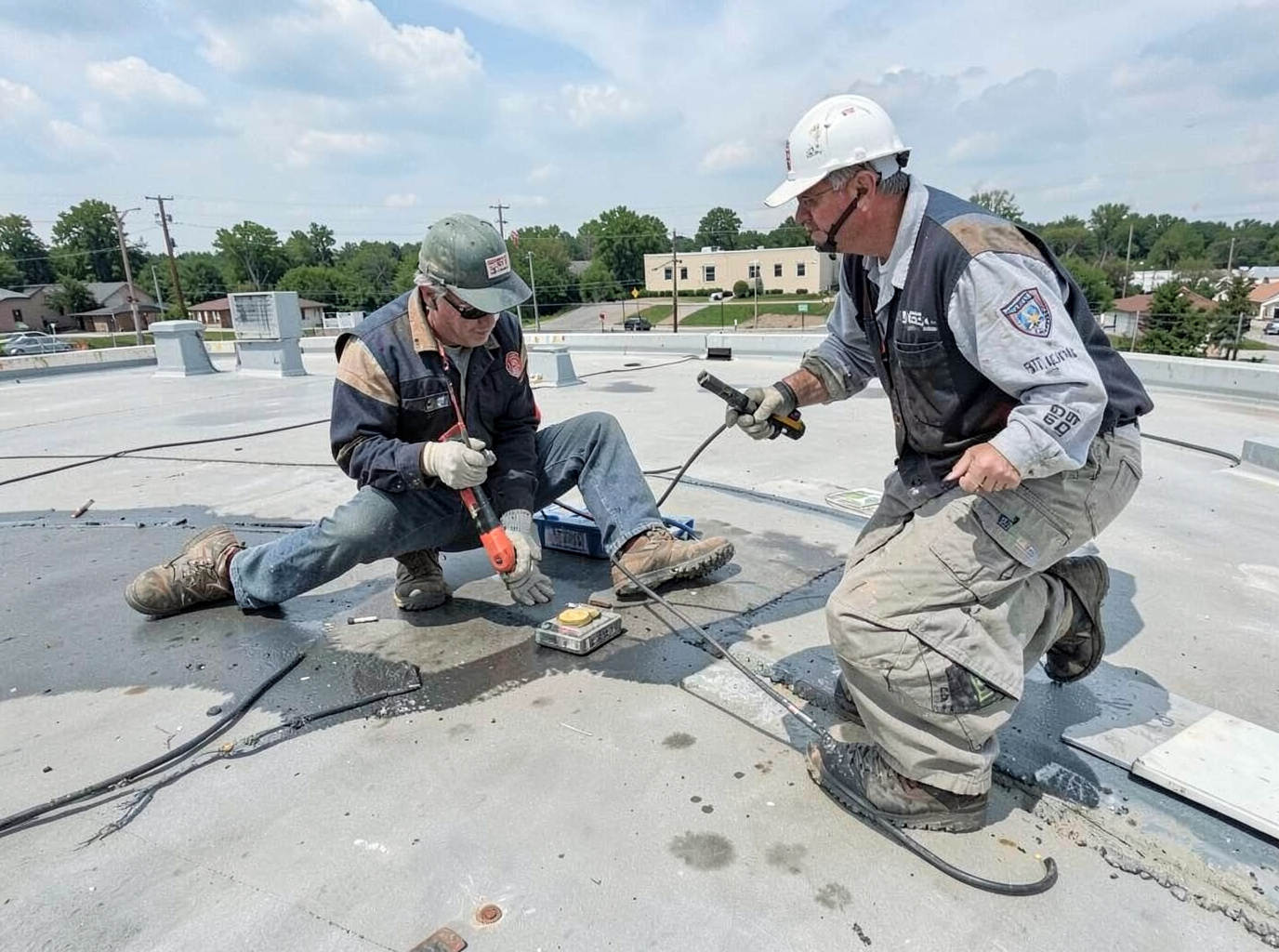
St. Joseph commercial buildings often feature older flat roof systems installed on masonry or steel structures common in downtown and industrial zones near the Missouri River. Freeze-thaw cycles combined with summer thunderstorms create seam splits and membrane shrinkage on TPO and EPDM surfaces. A roofing contractor must evaluate existing ballast, insulation condition, and perimeter flashings before any repair because poor drainage around HVAC curbs frequently leads to repeated leaks.
Edge cases include ponding water over aged modified bitumen where gravel surfacing has eroded, allowing UV degradation to accelerate blistering. Local code requires proper slope restoration during repairs to meet Buchanan County drainage standards, and crews must account for wind uplift ratings on exposed riverfront properties. Skipping tapered insulation additions during patch work often results in water migration under adjacent sections within one or two seasons.
Technicians inspect for concealed wet insulation by core sampling rather than relying on visual checks alone, since St. Joseph humidity can mask moisture trapped beneath single-ply membranes. Repairs incorporate compatible adhesives and termination bars rated for the region’s temperature swings, preventing delamination that occurs when incompatible materials meet at existing seams.
Technician insight
In St. Joseph the thing that catches most people out with Commercial Flat Roof Repair is how quickly freeze-thaw cycles along the Missouri River open seams on older EPDM and TPO systems; many owners wait until interior leaks appear instead of addressing the lack of positive drainage around HVAC curbs that develops every winter.
Industrial Building Near the Riverfront
Standing water collected around HVAC units on a modified bitumen roof in an older St. Joseph warehouse. Core samples revealed wet insulation under several seams. We installed tapered insulation to restore slope, welded new TPO patches over the damaged sections, and sealed all perimeter flashings. The roof now drains fully after storms.
Commercial Flat Roof Repair Services We Offer
✓TPO Membrane Patching
Heat-welded patches restore punctures and seam failures on thermoplastic roofs common to St. Joseph warehouses and retail buildings.
✓EPDM Seam Repairs
Adhesive and tape reinforcement fixes open laps on rubber membrane systems exposed to Buchanan County freeze-thaw cycles.
✓Modified Bitumen Restoration
Torch-applied or cold-process coatings and patches address cracking on built-up commercial roofs throughout downtown St. Joseph.
✓Flat Roof Drainage Improvements
Installation of additional scuppers and tapered crickets corrects ponding around HVAC units on local commercial structures.
✓Ponding Water Correction
Targeted slope adjustments and fill insulation eliminate standing water that accelerates membrane breakdown in St. Joseph’s humid summers.
Commercial Flat Roof Repair Cost in St. Joseph, MO
| Service | Typical Range | What Affects It |
|---|---|---|
| Small membrane patch | $400–$900 | Varies with material type and roof height |
| Seam restoration section | $800–$1,800 | Affected by length and insulation condition |
| Drainage improvement add-on | $600–$1,500 | Includes tapered insulation pieces |
| Full bay coating restoration | $1,200–$2,800 | Depends on surface prep and square footage |
Ranges are typical for St. Joseph, MO and confirmed with an exact written quote before any work starts.
How it works
- 1
Onsite Assessment
Walk the roof to identify membrane condition, drainage patterns, and flashings while noting access limitations typical of St. Joseph commercial sites.
- 2
Core Sampling and Moisture Scan
Extract samples and check for wet insulation beneath the membrane to determine the true extent of needed repairs.
- 3
Targeted Repair Execution
Apply compatible patches, seams, or coatings using manufacturer-approved methods suited to the existing roof system.
- 4
Final Drainage and Seal Check
Verify corrected slopes and perimeter details before documenting the completed work for the property owner.
Pricing
Costs depend on roof size, existing material, and access difficulty; onsite evaluation provides accurate scope.